
Although running or exercise in general, is associated with numerous amounts of physical, mental and psychosocial benefits, there is the looming fact that injury may occur. Below highlights some common knee injuries runners may face:
Patellofemoral Pain Syndrome (PFPS) aka Runner’s Knee:
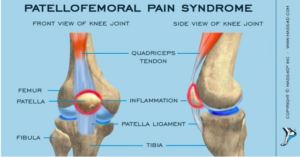
Patella = Kneecap & femur = thigh bone, giving rise to patellofemoral meaning between the kneecap and thigh bone. PFPS is commonly found in the front of the knee, under or around the edges of the kneecap and is often heightened when walking upstairs or jogging uphill. Identify causes of PFPS can be tricky, although the mechanism is often associated with patella mal-tracking (the knee cap not gliding properly in the grove) or overuse of the thigh muscles due to hip weakness causing them to tug excessively on the kneecap. Stiffness or even crepitus (knee cracking) may occur in individuals with PFPS after prolonged periods of knee flexion. In order to identify PFPS, this can be done through a comprehensive examination by a physical therapist or through X-ray/MRI if physician is unable to determine a specific cause.
Treating PFPS can be done through numerous options, although a combination of modalities is often best. Physical therapy improves musculature imbalances and strengthening areas of weakness which in turn leads to improved movement patterns during exercise. Taping of the knee or orthotics can also help decrease discomfort along with modifications to the individuals’ current training regime.
Patella Tendinitis aka Jumper’s Knee:
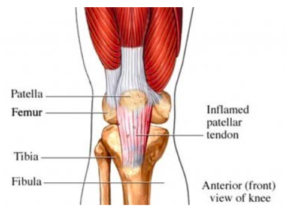
Tendons are the connective tissue that connects a muscle to a bone. Although a tendon, the patella tendon is in fact a ligament connecting the kneecap to the tibia (shin bone). When experiencing patella tendinitis, pain is felt during exercise and often causes swelling, redness or warmth at the lower part of the kneecap, over the patella tendon. Inflammation to this tendon is what differentiates jumper’s knee from runner’s knee. This form of injury is an overuse injury, mainly associated with downhill running.
In order to address patella tendinitis, a variety of modalities can be used:
Strapping may help to alleviate some of the discomfort by help displace the amount of stress placed on the tendon. Physical therapy involving stretching and strengthening of the hip and quadriceps muscles also help to alleviate stress to the tendon. A GP may prescribe medicines to help with pain reduction; however this will only provide short term temporary relief.
Ilitobial Band Syndrome (ITB):
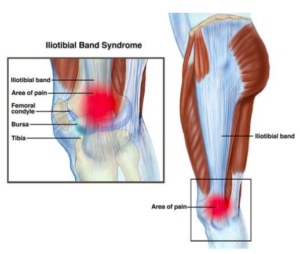
One of the most common forms of injury in runners, inflammation of the ITB is a result of repetitive motion. Friction between the ITB and lateral femoral epicondyle causes inflammation. Although the exact mechanism causing ITB cannot be fully explained, factors often aiding in the formation of ITB have been proposed:
Common symptoms of ITB are that of: sharp or burning pain just above the outer part of the knee, pain that worsen with continued repetitive motion, swelling, pain during early stages of flexion – flexion up to 30⁰ is known as the impingement zone).
Stretching and rest are key treatment components to ITBS. Pain may subside within a few weeks and gradual return to exercises is recommended. Whilst resting the ITB, modifications to your training schedule can help to maintain fitness. Physiotherapy and Physical therapy will assist to relieve the ITB, strengthen the musculature surrounding the hip, knee and foot, improve stability and proprioception as well as address running mechanics. Surgery may be considered if severe pain persists following correct conservative treatment, although rare.