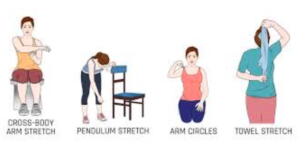

Adhesive Capsulitis or better known as Frozen shoulder involves pain and stiffness that develops gradually in the shoulder joint. Your shoulder joint consists out of three bones that form the ball-and-socket-joint. The three bones are the humerus, scapula and clavicle. The tissue around the joint called the shoulder capsule hold everything together.
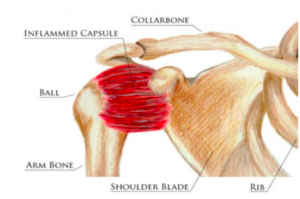
In the case of frozen shoulder, the shoulder capsule becomes very thick and tight and making it hard to move. One of the most common causes of a frozen shoulder is the immobility that may result during recovery from a shoulder injury or a broken arm. Some medical experts also refer to the frozen shoulder as a “self-limiting” condition, meaning it will eventually go away on its own. In some cases, people with this may not regain their full range of motion.
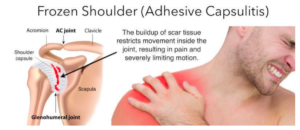
Frozen shoulder occurs more often in females than males. People in the age category of 40 and 60 are more likely to also suffer from this. Someone in the process of recovering from a medical condition such as a stroke or a mastectomy are also prone of developing a Frozen shoulder due to the limitation of movement of the shoulder.
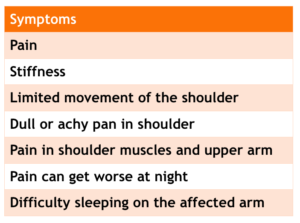
Symptoms for frozen shoulder that can occur:
There are three stages of frozen shoulder with specific symptoms for every stage as well as a timeline how long each stage would last:

When diagnosing a frozen shoulder, the physician will check your arm to see how badly it hurts and how far movement there is. You will go through an active phase where you would be able to move your own arm and then a passive phase where the physician will move your arm. Usually a physical examination will be enough to diagnose a frozen shoulder, but they will also send you for X-rays, ultrasound or an MRI to rule out things like arthritis or torn rotator cuff muscles.
Medication such as anti-inflammatory drugs (aspirin or ibuprofen) can help with pain and inflammation. Doing physical therapy like strengthening and stretching exercises will help to improve the range of motion of the shoulder.