

Just reading this condition out loud, triggers pain…this is when your fingers are stuck in a bent position, and snap straight.
In most cases, trigger finger is a nuisance rather than a serious condition. However, if it is not treated, the affected finger or thumb may become permanently stuck in a bent position. This can make carrying out everyday tasks difficult.
What is Trigger Fingers?
This happens when the tendon that controls that finger can’t glide smoothly in the sheath that surrounds it. This may occur if part of the tendon sheath becomes swollen, or develop a small lump, or a nodule forms on the tendon. This created the sensation of catching or locking when you bend or straighten you finger.
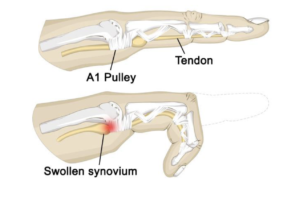
Symptoms:
This symptoms may progress from mild to severe, which include:
• Stiffness of the finger, especially in the morning
• The popping, clicking or snapping sensation of the finger
• Tenderness or a bump in the palm at the base of the affected finger.
• Finger catching or locking in a bent position, which suddenly pops straight.
• Trigger finger can affect any finger, and sometimes more than one.
• Stiffness and locking tend to be worse after periods of inactivity
Causes:
• Medical conditions. Trigger finger is more common in people with certain medical conditions, such as diabetes, rheumatoid arthritis and low thyroid function.
• Forceful hand activities. The condition is known to occur after forceful use of the fingers and thumb.
• Age. Trigger finger is more common in older (most common in women over age of 50yrs) individuals and is rare in children. However, there is a condition called congenital trigger thumb that can result in locked flexion of the child’s thumb.
• Usually trigger fingers often start gradually and no clear injury.
Treatments
Non-surgical:
This will Initially be the treatment for a trigger fingers.
• Rest. If possible, resting your hand may resolve the problem. Try to avoid activities that makes it worse.
• Splinting: wearing the correct splint at night – to keep the finger in a straight position while sleeping can be helpful.
• Exercises: very gentle stretching and mobility exercises can decrease stiffness and improve range of motion in the involved digit
• Medications: Over-the-counter medications is an option. The best will be ant-inflammatory drugs (NSAIDs).
• Steroid injections. Cortisone, is a powerful anti-inflammatory agent that can be injected into the tendon sheath at the base of the affected digit. In many cases, a steroid injection can resolve the condition. If symptoms do not improve with one injection or improve but then come back after a period of time, a second injection may be given. If two injections do not help the problem, surgery is often recommended.
Steroid injections are less likely to be effective in patients with diabetes but may still help avoid surgery. They can cause a short-term rise in blood sugar, so glucose levels in diabetic patients should be monitored closely after injection.
Surgery:
• Surgery is an option if you have loss of function of your digit, or if your pain is not getting better. If your finger are stuck in a flexed or bent position and cannot be straightened with gentle manipulation, your doctor may recommend surgery to prevent permanent stiffness.
• The surgical procedure for trigger finger is usually trigger finger release.
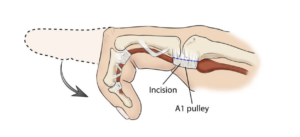
The goal of the procedure is to release the A1 pulley, which is the pulley responsible for blocking tendon movement (blue dotted line). After release, the flexor tendon can glide more easily through the tendon sheath, making the clicking/catching sensation go away. Typically, trigger finger release is an outpatient procedure, with an injection of local anesthesia to numb the area for surgery. It can be performed with or without sedation.